
When you ask women, “What are the barriers to improving your family’s income?” you learn something surprising. All around the world, in low-, middle-, and high-income countries, they cite the same thing: accessible and affordable child care. Without a safe and healthy place for their young children to go, mothers are less able to earn money to help support the family. This is especially challenging in places where maternal care and newborn support systems are scarce.
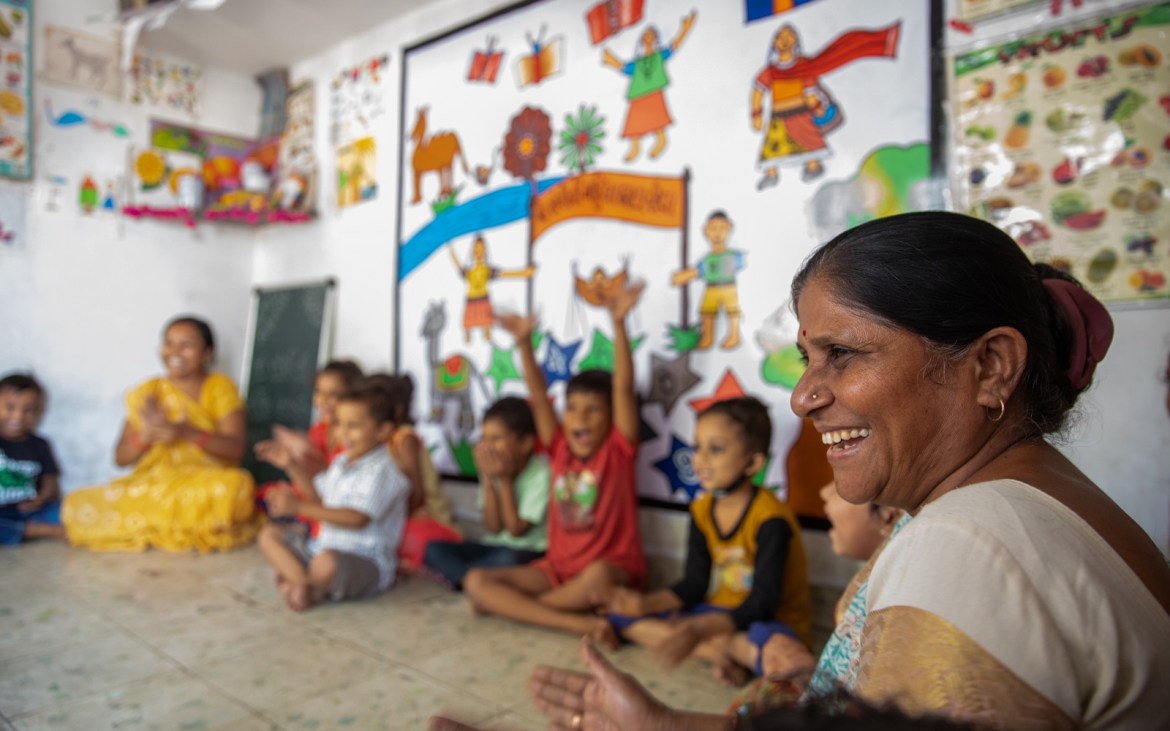
In Gujarat, India, a child care center known as a crèche provided a pathway out of poverty for Jashodaben Pravinchandra and her family.
Why High Quality Affordable Child Care is Important
Around the world, many different models have sprung up to provide care for children while their parents are working. Some are government sponsored, some are supported by nongovernmental organizations (NGOs), and some are shared among community members. Some of them focus on eliminating malnutrition, creating opportunities for early childhood education, while others focus on holistic child development, and still others include health care and other services. But they all have one thing in common: Everyone benefits.
Affordable child care is important as an investment in women and children that leads to a positive economic impact for so many.
Connections between child care and health
Decades ago, women were helping to start child care programs because they didn’t want to take their children to job sites or leave them home alone while they worked. They knew that access to child care would enable more women to work, safe in the knowledge that their children were being well cared for and that they could earn a better income for their family.
Years later, considerable research has confirmed that these women were right about their family’s income and so much more. Studies have shown that access to quality child care can improve children’s mathematical reasoning, cognitive skills, and psychosocial outcomes. It has also helped ensure that children get enough protein and vitamins. It even helps improve their height and weight. This is a clear demonstration of the impact of child care on child development.
So what’s the problem? Globally, more than 40% of all children below primary school age—nearly 350 million—need child care but do not have access. As a result, small children are often left in the care of an older sibling, usually a girl who must then forgo school. The negative effects span generations.
Economic impact of child care—more jobs, income, and growth
Fortunately, there’s an opportunity to build on existing programs and expand the child care infrastructure. In India, the government launched the Integrated Child Development Services (ICDS) program in 1975, and it has grown to 1.4 million child care centers. Other programs in India are run by states, such as those in Chhattisgarh and Odisha. The Self Employed Women’s Association (SEWA), the largest trade union representing self-employed women workers in India (and a foundation grantee), has been operating child care centers for decades. Mobile Creches, an NGO, provides care for thousands of children at construction sites. And the list goes on and on.
When even more families gain access to care, the return on investment will be significant.
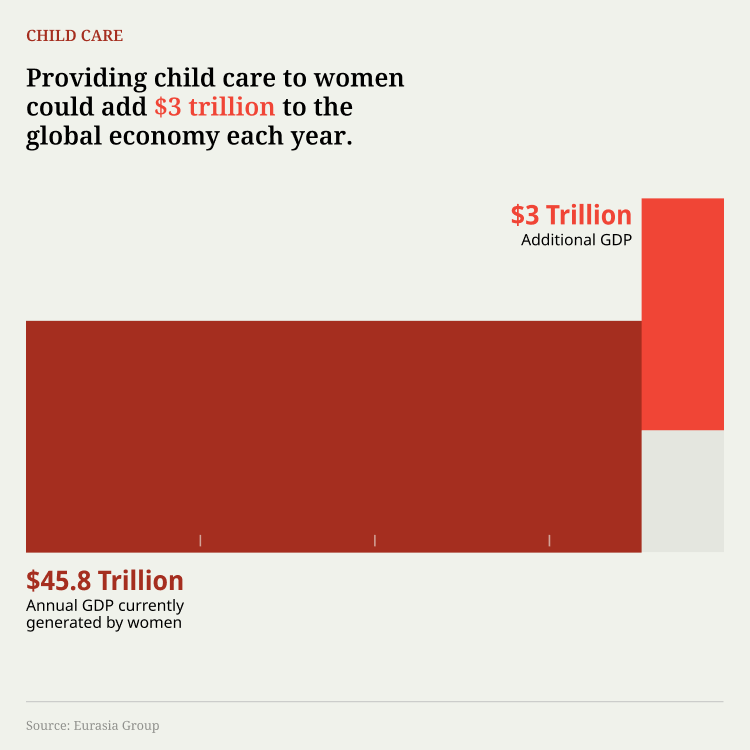
The economic benefits of accessible child care serves those most in need
Proportionately, low- and lower-middle-income countries stand to benefit the most. In India, for example, small community-based studies have shown that, on average, women workers’ incomes double when they have access to full-day, comprehensive, quality child care.
You know what else expanding child care infrastructure would do? Create jobs.
You know what else expanding child care infrastructure would do? Create jobs, many of them for women, helping narrow the gender gap when it comes to economic opportunity. Expanding the child care workforce to meet current needs could create 43 million jobs globally.
As our foundation’s co-chair Melinda French Gates has said, “[I]t’s time to start treating child care as essential infrastructure—just as worthy of funding as roads and fiber optic cables. In the long term, this will help create more productive and inclusive post-pandemic economies.”
For anyone asking why child care is so important, the answer is clear.
Investment in child care means more income for families—for quality food, early education opportunities, and savings. It means more jobs and inclusive economic growth. It means better futures for children, and more productive working adults. In sum? Everyone wins.