When Dr. Loice Achieng Ombajo was 16 years old, she was certain she wanted to be an engineer. Or maybe an architect. But she definitely didn’t want to be a doctor.
Then her world turned upside down.
“My mother got really sick,” she says. “I was taking care of her, and she died just a few months after I finished high school.”
Losing her mother was impossibly painful. Making matters more difficult, no one would answer her many questions, like why did this happen? And could anything have been done to help her mother?
“Everybody thought I was still a child, perhaps. There was very little communication with the doctors. They didn’t explain to me what was going on, and I was left with so many questions.”
It didn’t take long after that for Loice to realize that her mother’s death had changed her professional dreams forever.
“I remember calling an uncle of mine and telling him, I want to do medicine.”
Loice saw herself doing research to make sure people had access to the answers and cures they needed. And she hoped to be a voice of compassion for patients and their families, to walk with them hand in hand during the hardest times of their lives.

The Bill & Melinda Gates Foundation proudly partners with experts, communities, and individuals across the world who are relentlessly fighting for human potential.
The next emergency strikes
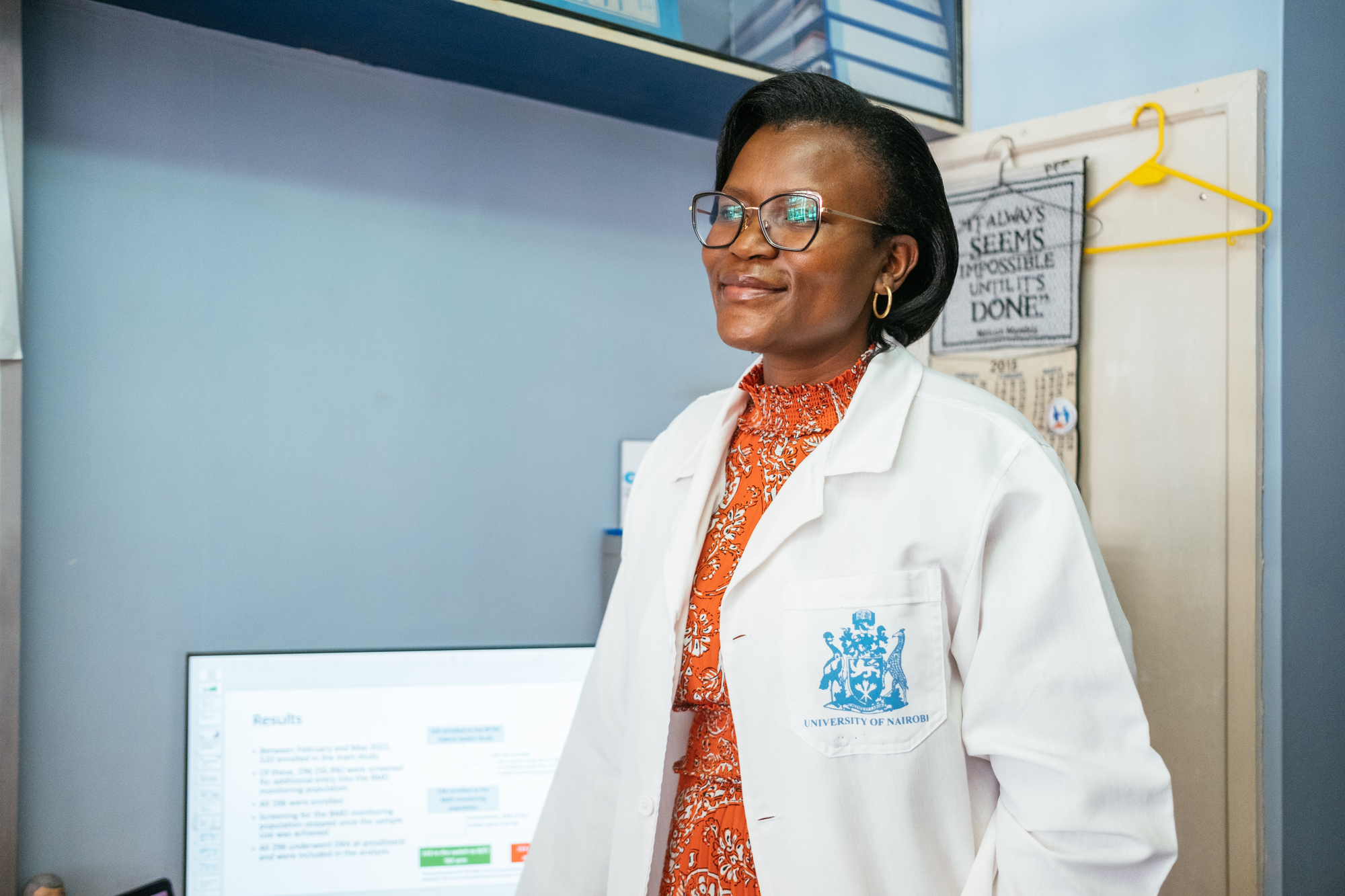
Loice became an infectious disease specialist, eventually serving on the faculty at the University of Nairobi medical school. She spent her days in clinics, labs, and classrooms, treating people and teaching students. She always answered patient questions with the compassion she had needed as a young girl mourning her mom.
Then, in early March 2020, the COVID-19 pandemic reached Kenya.
“There was a lot of panic,” she says. “We had seen what was happening in China, what was happening in Europe. Health care workers were scared, the general public was scared, and the media was in a frenzy.”
Subscribe to The Optimist to get weekly updates on the latest in global health, gender equality, education, and more.
By submitting your email to subscribe, you agree to the Gates Foundation’s Privacy & Cookies Notice.
Along with her colleagues Thumbi Mwangi, an epidemiologist, and Shikoh Gitau, a computer scientist, Loice realized that Kenya needed answers. How long would it take to reach 1,000 cases? 10,000 cases? Which populations were most vulnerable? These insights could help medical providers prepare so that more lives could be saved.
They mobilized quickly and gathered what data they could. “We started looking at an initial prediction of what might actually happen in different parts of the country,” Loice says.
Their grassroots effort grew to become the Center for Epidemiological Modelling and Analysis (CEMA), Kenya’s first-ever epidemiological modeling center.
“I personally was involved in a lot of media engagement, a lot of public education—calming people and saying, You know, COVID will come, but we are finding a way to make sure it doesn’t kill all of us.”
Instead of providing reassurance and answers to individual families and patients, Loice became a source of solace to an entire country.
No regrets, only progress
CEMA’s modeling proved invaluable to Kenya’s pandemic response. The Ministry of Health and Ministry of Education looked to the CEMA team for guidance. The president of Kenya even cited their findings on live television.
Today, the organization is on track to do much more, not only tracking public health trends across the nation but also training Africa’s next generation of data experts to do this work. The Gates Foundation is helping to fund this work.
Thinking back to her high-school-aged self, telling her uncle she was determined to become a doctor, Loice says: “It was big talk at the time—I didn’t quite know what I meant. But I felt I could give more. And I have no regrets.”