
When Bill and Melinda started the foundation in 2000, they envisioned a future where everyone would have a chance to live a healthy and productive life. And for the first two decades of the 21st century, the world was on track to make that vision a reality. Child deaths were cut in half. The global poverty rate fell by three-quarters.
But today, that progress is at risk. We continue to reckon with the damage caused by COVID-19—while also facing a confluence of economic, climate, and geopolitical crises. Around the world, people have stepped up in their own communities in inspiring ways. But all sectors must do more to ensure that all people, no matter where they live, can achieve their full potential. To accelerate progress toward our collective goals, we need long-term, sustainable action.
To meet the moment, the Bill & Melinda Gates Foundation is announcing our intent to increase our payout by 50% over pre-pandemic levels, from nearly $6 billion to $9 billion annually by 2026.
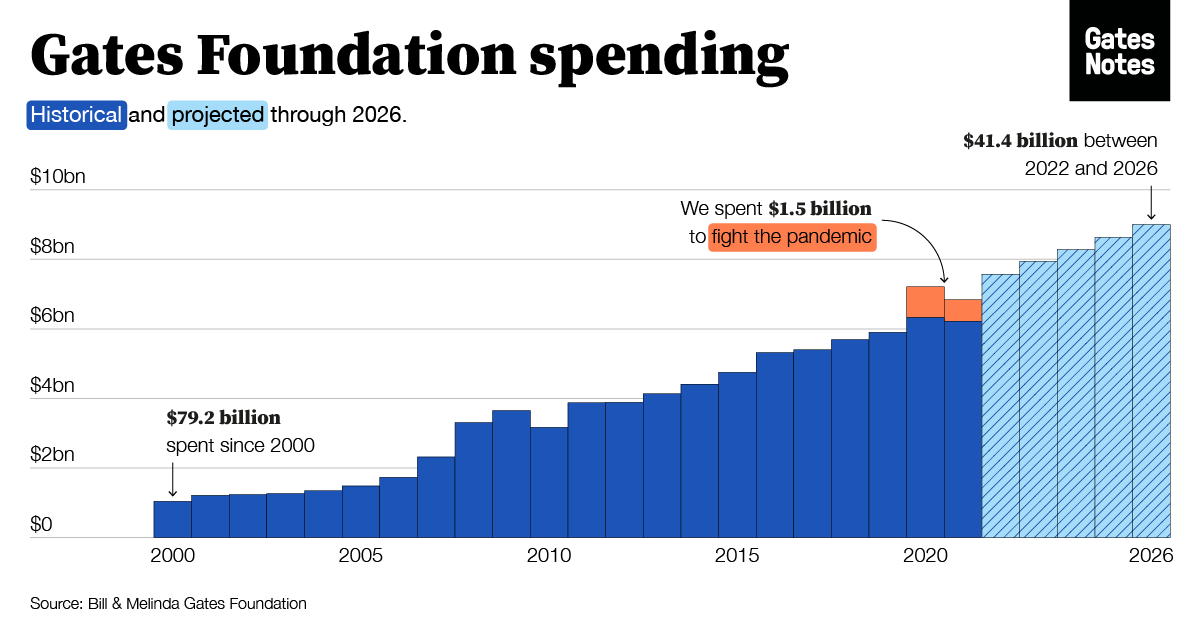
This increase is the result of two decades of generous contributions from Bill Gates, Melinda French Gates and Warren Buffett, including their recent gifts to the foundation’s endowment. Today, Bill announced that he is transferring $20 billion to the foundation’s endowment this month and reiterated his intention to give nearly all his wealth to the foundation. This gift meets and exceeds Bill and Melinda’s commitment last year and builds on Warren’s immense generosity, including his $3.1 billion gift in June.
So what does this mean for our partners and grantees? Are our focus areas changing? In a word, no. With the support and guidance of the board, we intend for these resources to enable us to deepen our commitment to our existing focus areas. With this sustained increase, building on a decade of increasing annual payouts by the foundation, we will work to ensure that innovative solutions—in health, gender equality, agriculture, financial inclusion, and education—reach as many people as possible, as soon as possible.
None of this happens without our strong, diverse partners.
Especially in times of crisis, philanthropy has a unique role to play. We can take on risks that may not be financially attractive or feasible for the private sector or governments, step in where markets fail to help the most vulnerable, and fund R&D that would otherwise never leave the lab.
In his post today, Bill writes: “focusing on being part of the solution is better than giving up in despair.” I agree. But I also know that we are just that: part of the solution. None of this happens without our strong, diverse partners. As Melinda said today: “this additional spending will support our partners’ important work to promote a fair and inclusive recovery and a healthier, more equal future.” We are committed to strengthening regional and domestic capacity from discovery to delivery, to achieve sustained impact at the local level.
If we meet this moment with the urgency it deserves and the resources to match, we can get back on track and make a profound impact.
As the leader of this foundation, people often ask me what I’m optimistic about. Despite the challenges we face, I can answer honestly: I know that when we collaborate, we can change the world for the better. I saw this at the United Nations, where I helped launch the Millennium Development Goals. These goals and their successors, the Sustainable Development Goals, were adopted by countries around the globe and represent a collective commitment to a more equal future for all people. If we meet this moment with the urgency it deserves and the resources to match, we can get back on track and make a profound impact.
The alternative is unacceptable. We cannot accept a status quo where the location of a child’s birth determines whether she has access to safe sanitation, routine immunizations, or a quality education. We cannot sit back while the people who have done the least to contribute to climate change suffer its most severe consequences. We cannot ask another generation of women and girls to wait for equality. They have waited long enough.
It will take all of us: governments, philanthropies, NGOs, activists, and the private sector. But together, we can accelerate progress and create a more equitable world for all.