
M. Hari Menon, head of the foundation’s India office, wrote on India’s initial COVID-19 response in May 2020. We caught up with him to discuss his thoughts on the pandemic at the end of the year and what’s to come in 2021.
2020 was a really tough year, but optimists that we are, we’re always looking for the silver linings. And there were a few this year. When India’s government launched an organized push to counter the pandemic in March 2020, we aligned with the national response and were able to contribute timely technical support, as well as some catalytic funding, to a variety of partners engaged in the fight.
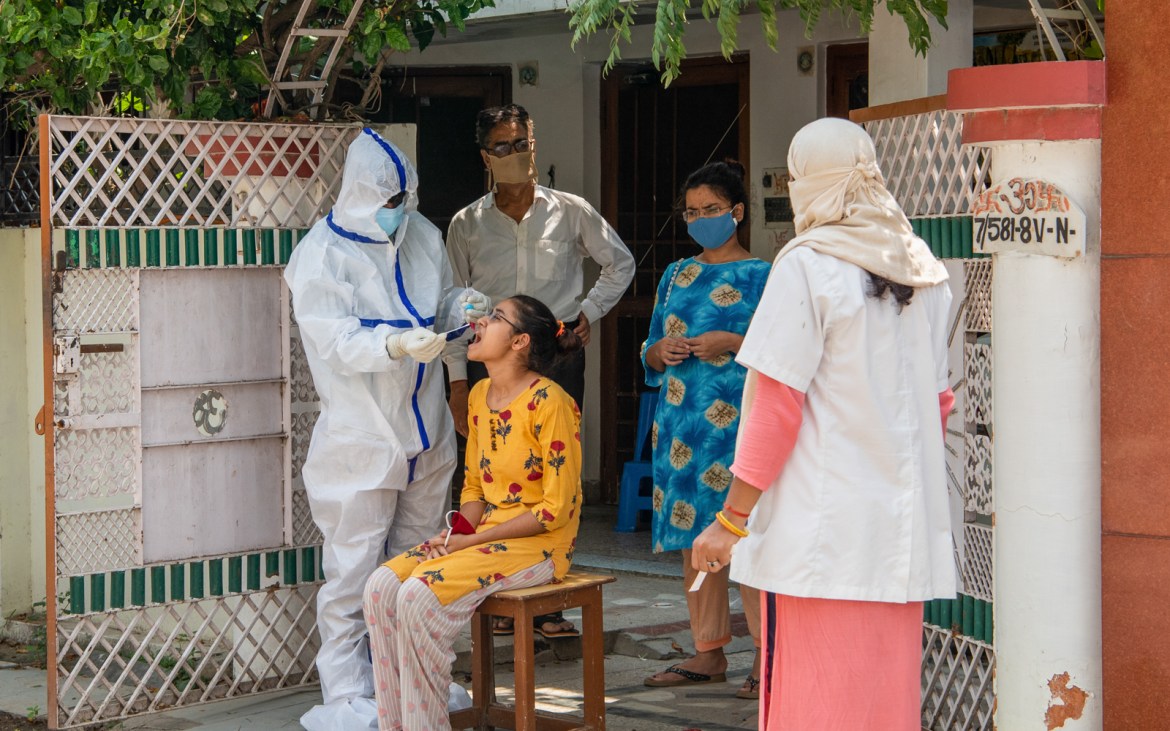
We provided technical assistance and funding to partners in our priority states of Uttar Pradesh and Bihar to help strengthen both their COVID-19 planning and response, as well as their health systems on the ground through programs underway before the pandemic. We’ve also supported states’ efforts since to rebuild essential and critical primary health services that have been disrupted by the pandemic. We helped contribute to India’s massive scale up of testing across the country, as well as the government’s effective mass media campaigns to promote safe behaviors like mask wearing and social distancing.
Another critical partner this year has been the Serum Institute, a key Indian vaccine manufacturer. Serum has deals in place with Novavax and AstraZeneca to manufacture their COVID-19 vaccines in 2021, and the funding that the foundation provided through Gavi will contribute several hundred million doses of these vaccines for use in India and other countries in need, pending regulatory approval. This has the potential to accelerate the world’s bounce back from COVID-19 in 2021.
One major challenge is that India, like many other countries, hadn’t had any large-scale pandemic response machinery in place for several decades. So, the government was forced to effectively construct that machinery even as COVID-19 was spreading across the country. At the same time, India also had to scale up its diagnostics and screening infrastructure on a level that had never been done. The government has made impressive progress on both fronts over the year, but, especially in the early days, lack of testing was often a problem.
Another tremendous challenge was the total shutdown of essential health service delivery in the early months of the pandemic, and the impact that has had on the core health programs that people rely on. For nearly 2-3 months, frontline health workers and health facilities just could not function effectively, and the government has had to put in hard and rapid action to turn that around. The recovery is clearly visible now, but there is a long way to go.
Finally, India also experienced steep economic setbacks in the April-to-June quarter, with a GDP dip of more than 20% as a result of COVID-19. There is a strong rebound visible but GDP for the full year is expected to decline 7%, a far cry from the +6-7% growth rate over the last two decades. More policy action will be needed to mitigate the economic impacts of this downturn on poor and marginalized populations.
Subscribe to The Optimist to get weekly updates on the latest in global health, gender equality, education, and more.
By submitting your email to subscribe, you agree to the Gates Foundation’s Privacy & Cookies Notice.
If we had known back in February or March that masks were going to be so effective, I think it might have been possible to reduce both some of the initial hysteria surrounding the disease and the severity of the initial lockdowns. The COVID-19 response could have been more calibrated, and the massive economic shock that resulted could have been mitigated, if we’d understood the transmission dynamics better.
Along the same lines, we didn’t realize that fatality rates would vary so much around the world. India’s pandemic response was informed by the death rates seen in Western Europe and the United States. But COVID-19 played out differently in most of the developing world, in part due to younger populations. If we’d known about this differential earlier, we might have been able to put in place a more nuanced response to the virus without shutting down the economy. Of course, this is all hindsight. In March, lockdowns were recommended by public policy experts and that’s what virtually every country did.
Obviously, COVID-19 vaccines will be one of the most important interventions in 2021 to stem the virus, revive the economy, and infuse confidence and optimism back into society, which is essential both for social cohesiveness and economic recovery. Indeed, vaccine rollout is not only going to be the biggest public health initiative of 2021 but arguably the most important public health initiative of our times.
I think India is well-positioned to hit the ground running here. We are likely to have some of the Indian-manufactured vaccines early in the new year, and the government has put a vaccine delivery plan in place for at-risk populations and essential health workers. Scaling up that rollout in 2021 will be essential.
Vaccines will be critical to ending COVID-19, but they are not a silver bullet. Governments will need to continue taking measured approaches and continue to encourage social distancing and mask wearing for a good while. We must also continue to invest in improved diagnostics that have faster turnaround times, higher reliability, and are easier to administer. Improved rapid antigen tests and new types of tests that rely on CRISPR technology are being rolled out in India, and these hopefully will become more available.
These new vaccines and tests shouldn’t benefit just wealthy countries, or the wealthiest people in poorer countries. The only way for nations like India to recover economically in 2021 is by getting the marginalized people who’ve been hit hardest by the virus back to work and back into the economy.
Similarly, another critical area of focus in 2021 is recovering from all the setbacks to essential health service delivery. We saw drops of 80-90% in service coverage in some areas due to the virus. That has now started to improve but getting back to pre-COVID-19 levels—and then onto the Sustainable Development Goal targets—will take time and significant effort. The pandemic also made clear that lack of essential health services is a problem in big cities as much as rural areas, so we must remedy that as well. The good news is the government is aware and is working towards improvement of these services.
Finally, we are excited to support the Indian government in their plans to build on the COVID-19 response to achieve better pandemic preparedness for the future, through laboratory-based disease monitoring, more robust health IT infrastructure, and stronger public health systems that can deliver faster, better health care for all Indians. This is a space I’ll be watching with interest in 2021.