
U.S. Education
Understanding the value of education—and how to define it.

2019 Progress
“What is college worth?” With education costs, student debt and income inequality all rising, it is an increasingly urgent question. And in 2019, we set out to try to answer it.
The reality is that today, the opportunity to achieve an education after high school is not equal: a white adult is twice as likely as a Hispanic adult to have at least an associate’s degree. And a high-income student is five times more likely than a low-income student to have a bachelor’s degree by age 24.
We are already working with colleges and universities, and the organizations that support them, to close those opportunity gaps. But we believe more needs to be done to dig into the question of whether and how colleges and universities create value for students, especially low-income students, first generation students, and students of color. So earlier this year, we and our partners at the Institute for Higher Education Policy launched the Postsecondary Value Commission.
The commission has an ambitious charge: Define and measure the value of education after high school, and equip students, families, college and university leaders, and policymakers with that information to promote change that increases the returns of postsecondary education.
Representing a range of perspectives, from institutional leaders and researchers to policymakers and current students, the commission began by looking at existing research, considering how to measure and balance economic and non-economic returns of education after high school, and started to flesh out a framework for measuring value.
—Patrick Methvin
Director, Postsecondary Success, United States Program
Making a collective impact in the Rio Grande Valley
By Allan Golston


Why ranking college rankings matters
By Allan Golston

Creating a pathway for students
3X
A child born into the bottom 20% income bracket is 3x more likely to reach the top 40% if they go to college
1.6T
Dollar amount of current outstanding student loan debt in the U.S.
58
Percent of people who feel students get a “good” or “very good” return on investment from colleges in the U.S.
In case you missed it

What is college worth?
Like many, I am drawn to the rags-to-riches promise of the American Dream. It was a dream come true for my mother, the daughter of Slovenian immigrants whose father was a coal miner. She went to college, rose to the middle class, and sent all seven of her children to college and onto good jobs. Historically, education—especially higher education—serves as the bridge between struggle and success in America.
But in the face of mounting student debt, young adults with college degrees still financially dependent on their parents, and stories of admissions scandals, many—including those of us at the Bill & Melinda Gates Foundation—are today asking: What is college worth?
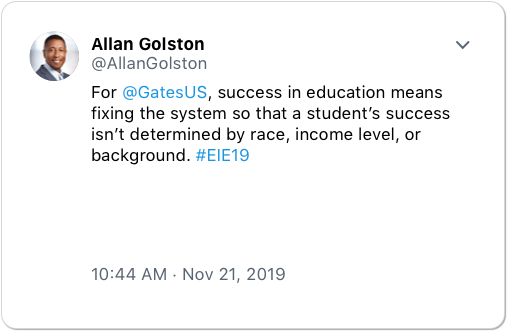
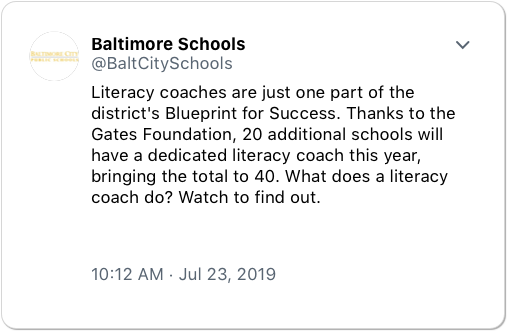
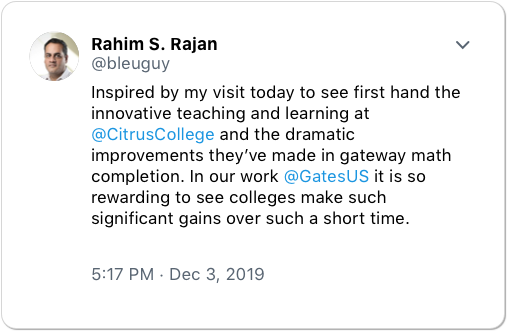
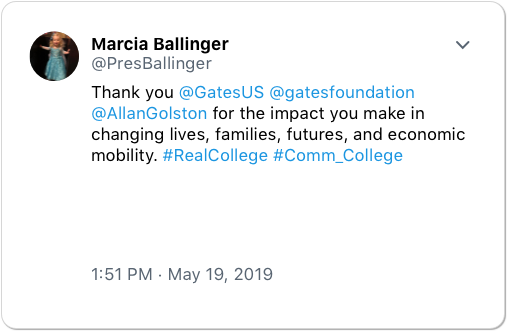
2019 in Tweets
What’s Next?
In conversations the Postsecondary Value Commission is having across the country, one question dominates: can defining value in education after high school be done?
It’s a fair question—and one we’ll keep exploring in 2020. After all, higher education is a complex and diverse enterprise, with more than 4,000 institutions of different sizes and missions. Any attempt to define or measure value has to take those differences into account and reflect economic and non-economic benefits for students, families and their communities.
But defining and measuring value can’t not be done, given the importance of education to economic and social mobility and the urgent need to address race and income gaps. And that’s why we’re looking forward to the Postsecondary Value Commission releasing their findings next year and providing a framework for better understanding the returns that students, families, and taxpayers get for their investment in postsecondary education.
That framework will also guide our efforts as a foundation, as we work with and seek partners who share our commitment to ensuring the best possible returns for today’s students, especially low-income and first-generation students and students of color.
What is college worth? It is a simple question without a simple answer, but it deserves the best answer we can give. And in 2020 that’s what the Postsecondary Value Commission will do.
—Robin Martin
Deputy Director, Postsecondary Success, United States Program