

A Q&A with Emily Nickels and Nicolas Theopold
In May, Senior Program Officer Nicolas Theopold spoke with us about the foundation’s call for high-income countries to share at least 1 billion COVID-19 vaccine doses by the end of 2021 and accelerate vaccination in lower-income countries. In light of the continuing spread of the highly contagious Delta and Lambda variants, we followed up with Nicolas and fellow program officer Emily Nickels on recent dose-sharing pledges, the impact of dose sharing so far, and why doses are needed right away.
Subscribe to The Optimist to get weekly updates on the latest in global health, gender equality, education, and more.
By submitting your email to subscribe, you agree to the Gates Foundation’s Privacy & Cookies Notice.
Nicolas Theopold: First off, we were encouraged to see the big announcement from the G7 nations to share 870 million doses with lower-income countries—it illustrates that these governments understand the moral and practical importance of vaccinating everyone and are starting to step up. As the spread of variants of concern is showing all too well, the world will not be safe from COVID-19 until people in every nation can protect themselves and their families through immunization. Until that happens, people all over the world will face continued hardship and terrible tragedies, and COVID will have more opportunities to mutate and proliferate.
The G7 announcement, along with previously committed doses, was an important step that brings dose-sharing commitments close to 1 billion doses. That said, the proposed timing for sharing these vaccines is not what we and many others around the world had called for. The majority of these doses will not be shared before 2022, but they’re desperately needed now: Lower-income countries have received less than 1% of total vaccine doses to date, leaving their populations unprotected and making it difficult to build out the systems to vaccinate quickly. Now, with variants of concern accelerating the spread of COVID-19, the pandemic is surging in Africa, Latin America, and other places where doses have been hard to come to by.
Emily Nickels: Some of the supply problems that have slowed vaccine rollouts should hopefully start being resolved by October, as more vaccines get approved, more manufacturing capacity comes online, and more COVAX deals mean that more shipments will be heading to low- and middle-income countries. But four months is a long time in this pandemic, so we really need to step up the pace of dose sharing right now.
Nickels: The recent surges driven by variants of concern have been devastating for many countries all over the world—we’re seeing health systems overwhelmed, severe oxygen shortages, and heartbreaking hospitalizations and deaths. Many nations with limited resources that have nonetheless been able to keep COVID at bay for 18 months are now seeing their worst surges of the pandemic. The world really can’t afford to wait until 2022 or 2023. That’s why, for example, the director-general of the World Trade Organization, Ngozi Okonjo-Iweala, recently called on wealthier nations to share 2 to 3 billion more doses as soon as possible.
Theopold: When vaccines can be and are shared varies by country, of course. As I noted in May, the figure of 1 billion doses by the end of the year is based on conservative assumptions, and the actual number of extra doses is likely to be much higher: We estimated that high-income countries would vaccinate 80% of their populations 12 and older this year and give boosters. But to take just one example, the U.S. is still working to reach 70% of its population 12 and older, and it remains unclear that boosters will be given to every person this year. If anything, the best way for higher-income countries to boost the impact of their vaccines in 2021 would be to ensure that more people everywhere are vaccinated, so the virus has fewer chances to mutate and overcome barriers.
Since the G7 announcement, we have been seeing more high-income nations get to the point where they have more doses than people to vaccinate. While each country is in a different place, every nation will likely follow the same path: When vaccines are first introduced, there is tremendous demand but very little supply, and countries need to put in place the infrastructure to deliver the shots. Then comes the ramp-up phase, when both vaccine supply and public health infrastructure increase and many people get vaccinated in a short time. Eventually, vaccine supply overtakes demand and the public health task becomes reaching pockets of people that either don’t have good access to health care (and therefore vaccines) or people who question the value or purpose of vaccines or have been hesitant to take them.
The U.S. reached this third phase of “demand tailoring” in April, the UK in late May, and other countries are following the same trend. In the past few weeks, we’ve seen more countries that are approaching this final phase raise their commitments. Switzerland recently upped its COVAX pledge from 3 million to 4 million doses, and the Netherlands also bumped up its commitment.
We are hopeful that higher-income countries understand the urgency of increasing their sharing, since billions of people are waiting for vaccines. The good news is, once COVAX receives shared vaccines, they can get them out the door very quickly. COVAX has shipped over 135 million doses to date and, despite the supply problems, still expects to supply around 1.9 billion doses by the end of the year. They’ve also been doing the hard work to build up the infrastructure and mechanisms to channel shared vaccines effectively and equitably.
We need these vaccines in the field — the sooner the better. Even small volumes can make an enormous impact in the race against the virus and its variants.
Emily Nickels
Program Officer, Global Delivery Programs
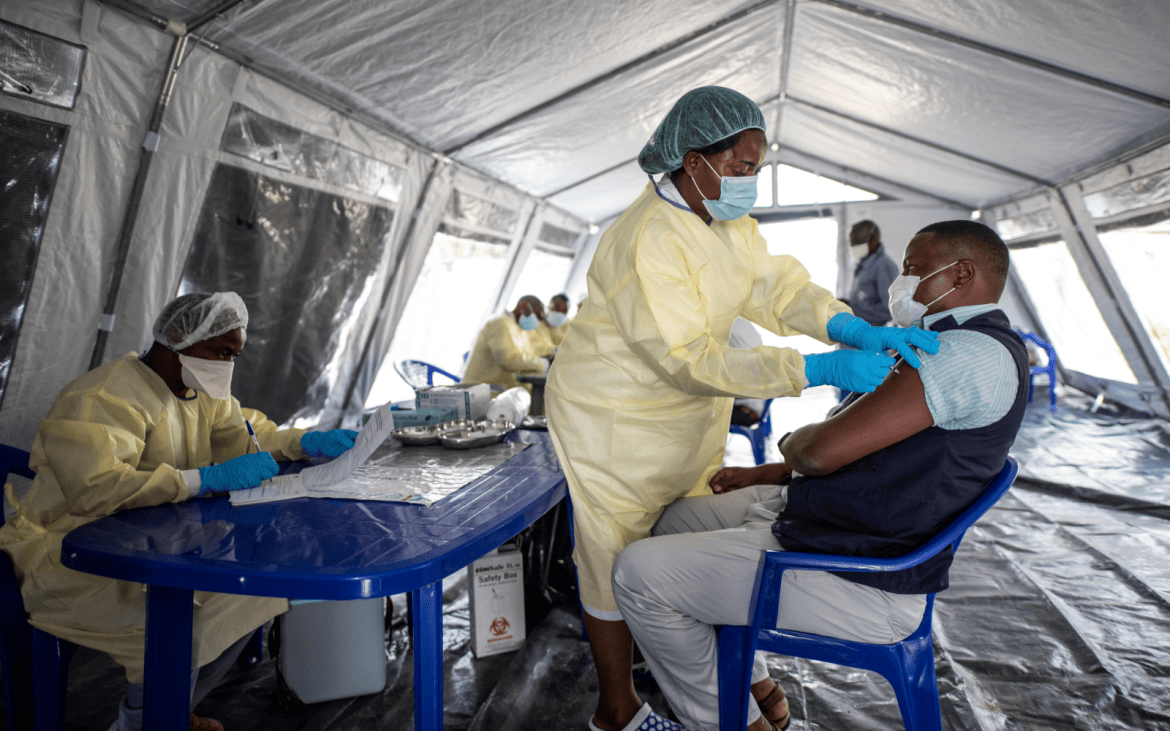
Nickels: Absolutely. Most low- and middle-income countries are still stuck in the first phase of rollout, desperately waiting for vaccines to reach them even as COVID-19 cases explode. So any doses that have hit the ground have been extraordinarily helpful. For example, France—the first country to give domestic doses through COVAX—has donated 1.8 million doses to African nations and has helped to shore up vaccination programs there in the midst of a terrible surge. As part of its plan to share 80 million doses through COVAX in the near term, the United States has been sending large shipments to nations in Latin America and Asia, including 3 million doses to Guatemala, 1.5 million doses to Honduras and El Salvador and 2.5 million doses to Bangladesh and Pakistan, respectively. Just a few days ago, the U.S. announced that 25 million doses would be shipped to Africa soon. New Zealand has shared 211,200 doses with six countries, most notably its neighbor Papua New Guinea. And nations like China and India have also made substantial doses available to countries in need, via direct donation of domestically produced vaccines.
Considering the extreme disparities in vaccine rollout to date—about eight of 10 doses worldwide have been given to people in high-income nations—it’s true that dose sharing isn’t yet close to meeting the tremendous scale of need out there. But I think that’s the wrong way of looking at it: We are in a race against the virus and its variants. Every single shot we can get in an arm right now reduces suffering and diminishes the ability of COVID-19 to spread and mutate.
We need these vaccine doses in the field right away—the sooner the better. Even smaller volumes can make an enormous impact, especially if they are shared in the next three months. For people who are protected, it makes all the difference in the world, and we are helping reduce the risk of virus mutation. The G7 pledge was a great start, but it was only a start—there is a lot more work to turn these pledges into reality.