Artificial intelligence, if applied in the right ways, could vastly accelerate global progress in health, education, and economic opportunity. But one major barrier is keeping AI from achieving its vast potential: language.
2000+
languages spoken in Africa
An estimated 90% of the training data for current generative AI systems is in English. The consequences are especially significant in Africa, home to more than a third of the world’s languages. Many of those languages remain severely underrepresented online and in the datasets used to train AI—which means the technology could work least well for the people who could benefit from it most.
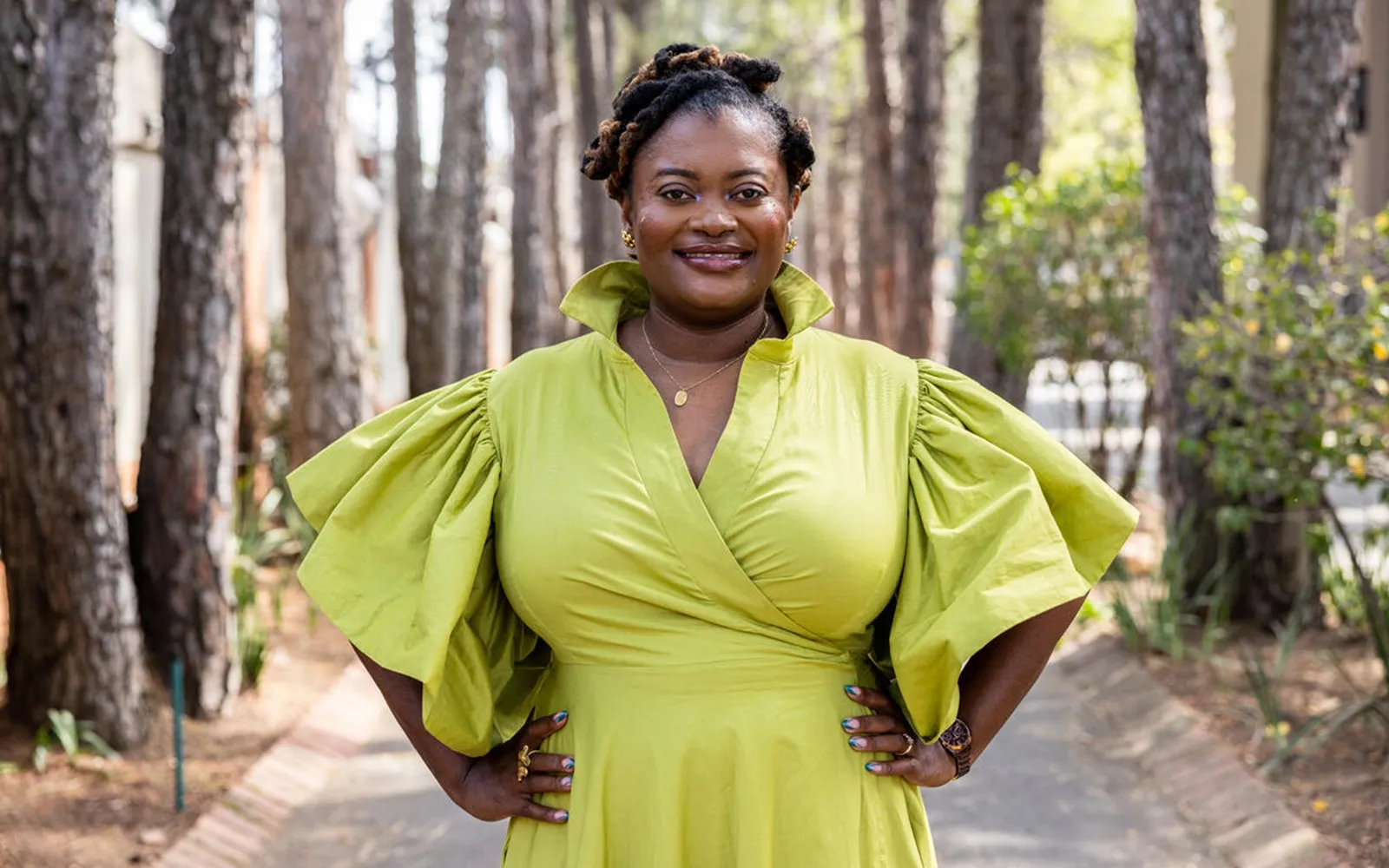
That’s why the Masakhane African Languages Hub, a community-anchored project of the Masakhane Research Foundation, is building datasets and supporting research to help AI understand Africa’s 50 most spoken languages. (Masakhane means “we build together” in Zulu.) Led by director and digital rights advocate Chenai Chair, it aims to ensure that AI works with and for Africans.
Becoming a digital disrupter
Even before the Masakhane African Languages Hub came together, Chenai Chair worked for years to ensure that digital technology empowers African communities. “I would call myself a ‘rabble-rouser’” in the tech world, says Chair. “I try to unpack power and demystify technology.”
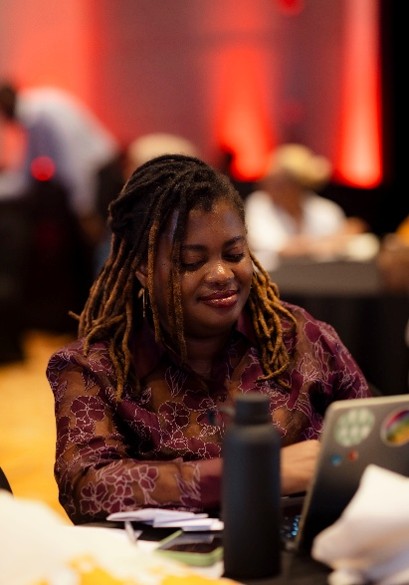
Chair’s journey to digital rights advocacy began with a happy accident in graduate school at the University of Cape Town in South Africa. When she missed a course registration date, she chose a different class that focused on mobile phone value chains and found herself absorbed by the subject. “These devices that were coming to the continent just for calling were making the informal economy happen,” she says. She ended up writing her master’s thesis on how South African women used mobile phones to support their informal businesses.
Chair went on to work in roles that explored how digital technologies were being adopted at the community level. These included doing public interest research at Research ICT Africa, a think tank focused on building evidence for digital justice, and researching gender-based digital inequality at the World Wide Web Foundation.
When COVID-19 hit, Chair was doing a fellowship focused on AI and privacy. Amid the surge of data apps to track and monitor the pandemic, she saw a need for greater attention to data justice from a feminist perspective when responding to crises.
Are we taking the time to ask the hard questions about the tools we are building?
This led her to launch My Data Rights, a project to advocate for better data and privacy protections, particularly for women and other marginalized groups. “That became a means of movement building for me,” she says. “I got to work with other like-minded researchers, artists, policy people, and builders and actually think about what it looks like to have a sense of ownership about technology. What does it look like to share information with people around their data rights? Are we taking the time to ask the hard questions about the tools we are building?”
Uncovering—and removing—digital biases
For Chair, those hard questions include examining and fixing the biases that influence how African communities, particularly marginalized groups, engage with digital technologies.
She first became aware of algorithmic bias when she googled “professional hair styles” and saw that it defaulted to straight hair, while dreadlocks, like hers, were labeled unprofessional. “I find if fascinating when my family members ask [popular chat bots] for advice,” she says, “and instead of nuanced local context, they get a very American or European lens. Whenever I try to talk to [voice assistants], I must finetune my accent or speak slowly—it will simply not hear me. If I want to hear African artists, I have to find the ones with easier names [that the device] can understand.”
“This is the reality of talking to your phone or trying to get your smart device to give you information,” says Chair. “If your accent is particularly distinct, it’s not going to work. Then I think about children or people with different speech capabilities. It won’t recognize a stutter, or the way someone with autism may speak, because it’s designed to understand [what the builders of the technology consider] a standard, normative way of speaking.”
If you build for the most marginalized, you will make a product that works for everyone.
The trick to reducing these types of biases, says Chair, is to design digital apps with inclusivity in mind from the outset. These tools “will be inequitable if you do not have women, queer people, African-led people, people who have been excluded being part of the process. They also must have a position of power—you cannot just tick a box to say OK, fine, we included them.” In other words, “if you build for the most marginalized,” the product will work for everyone.
The Masakhane African Languages Hub
The goal of Chair’s current project, the Gates Foundation-supported Masakhane African Languages Hub, is to bring this spirit of inclusivity and community empowerment to AI in Africa. Through its initiatives and grantmaking, the Hub supports artists, linguists, sociologists, AI developers, and many others, all working to ensure that AI tools deployed in Africa readily understand the continent’s 50 most spoken languages.
We “wanted to respond to the reality that African languages were not being documented at a digital level with machine translation and natural language processing,” says Chair. “The founders of the Hub couldn’t find the datasets. The knowledge wasn’t there, which made it seem as if African languages were unintelligible.”
under 5%
AI speech-recognition error rate in English
over 60%
AI speech-recognition error rate in Yoruba
For example, some leading AI speech-recognition models have word error rates below 5% for English, but error rates above 60 percent when trying to transcribe Yoruba, which is spoken by roughly 50 million people across West Africa.
To help remedy this, the Hub is compiling foundational datasets that focus particularly in the areas of agriculture, health care, financial services, education, and government services. “We have seen governments moving towards digital public infrastructure to provide [key services],” says Chair, “and if they’re not used by people, it’s seen as a failed project. But sometimes they’re not used because they’re not in a language people speak.” The Hub is working to ensure that these tools “are actually useful and take into account cultural nuances and context.”
What drives me to do this work is actually the joy. There is power in collaborative action. I’m part of a whole ecosystem.… This work isn’t possible if we as a community are not doing it together and trust it needs to be done.
Chair adds: “We don’t center the technology. We center people and their stories.” That focus on community is critical to all of the Hub’s work. “What drives me to do this work is actually the joy,” she says. “There is power in collaborative action. I’m part of a whole ecosystem…. This work isn’t possible if we as a community are not doing it together and trust that it needs to be done.”