
When I first began practicing as an obstetrician-gynecologist, I was surprised to find that most medications commonly given to pregnant women hadn’t been specifically formulated for use in pregnancy. But it was only when I transitioned to the biopharmaceutical industry that I saw how little health R&D funding goes toward women’s health conditions beyond cancer—less than 2% as recently as 2021, according to McKinsey & Company. The U.S. didn’t require federally funded clinical research to include women until 1993!
Today, women’s health issues are still too often misunderstood, misdiagnosed, or ignored. Although women generally live longer than men, they spend 25% more of their lives in poor health. Our foundation’s US$2.5 billion commitment aims to center women’s needs in a cutting-edge research agenda—particularly for those in underserved communities.
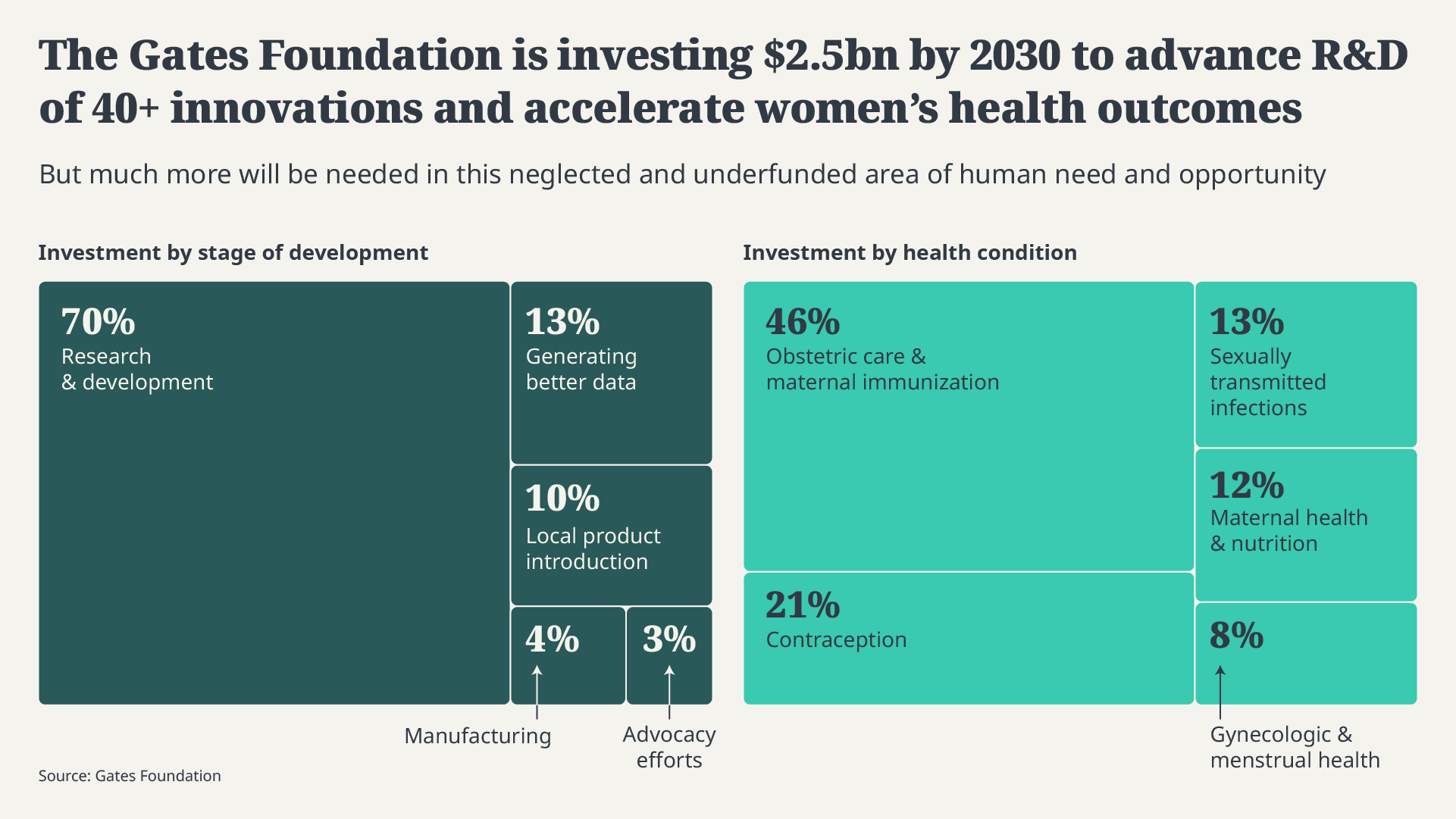
Our support will enable brilliant research teams around the world to advance more than 40 innovative women’s health solutions—explicitly designed for low-resource settings, where the needs are the greatest and the gaps are most urgent. This commitment is intended as a transformative opportunity for the field—and a call to action for governments and other funders who care about protecting women’s health.
Here are four of the potentially groundbreaking innovations this funding will support.
1. A self-administered contraceptive patch
Imagine getting six months of contraceptive protection by pressing a small patch onto your skin. Discreet and self-administered, the patch is embedded with microneedles containing progestin, the same hormone many women take in pill form to prevent pregnancy. The patch painlessly and gradually delivers protection over the ensuing months.
In many low-resource settings, women face significant barriers to consistent and reliable contraception. Many women in these communities want to have control over their reproductive health but do not use existing contraceptive methods because of male interference, concerns about side effects, or lack of access to options that meet their specific needs.
As a result, nearly half of all pregnancies worldwide—about 45%—are unplanned. The self-administered microarray patch addresses many of those concerns and puts the power in women’s hands.
2. Rapid testing for STIs
Picture this: a small, portable device no bigger than a can of soda delivering accurate STI results on the spot—without the need for a lab, and within minutes. A swabbed sample, even one collected by the patient herself, is inserted into a cartridge, and results are available during the same visit—enabling immediate treatment and reducing the risk of complications from delayed care.
Subscribe to The Optimist to get weekly updates on the latest in global health, gender equality, education, and more.
By submitting your email to subscribe, you agree to the Gates Foundation’s Privacy & Cookies Notice.
This kind of portable, point-of-care diagnostic tool could be a game-changer in low-resource settings, where access to STI testing is often limited or nonexistent. In many low- and middle-income countries, the lack of affordable, reliable testing means infections like gonorrhea and chlamydia frequently go undetected, with devastating consequences for women—including pelvic inflammatory disease, infertility, and adverse pregnancy outcomes such as preterm birth, low birth weight, and stillbirth.
3. AI-enabled ultrasound
Portable ultrasound devices that employ artificial intelligence (AI) are proving to be a valuable diagnostic tool for women in low- and middle-income countries. Low-resource, rural, and remote facilities may lack expensive equipment or health care workers with specialized training. These handheld tools connect to smartphones that run AI software, enabling health workers—even those without radiology training—to capture and interpret ultrasound images.
With new algorithms, the same device could help detect conditions like uterine fibroids, breast cancer, or cardiovascular disease—providing faster answers for women’s health issues that often go undiagnosed in low-resource settings.
4. Vaginal health therapies
Like the gut, the vagina has its own microbiome, and if it gets out of balance a woman can develop bacterial vaginosis—a risk factor for preterm birth and acquisition of STIs, including HIV. We support researchers who are studying the vaginal microbiome in women in Africa and Southeast Asia, yielding knowledge about differences between populations and how the microbiome can change in response to environmental conditions or location. The ultimate goal is to develop therapies that can restore and maintain an optimal vaginal environment.
Investing in women’s health is one of the most powerful ways to create a better world for all. As an OB-GYN, I’ve seen firsthand that when women are healthier, they are better able to make choices for their own lives and shape their communities. The benefits ripple outward toward everyone.
Closing the women’s health gap will save and improve millions of lives. It could also unlock US$1 trillion in global economic gains each year by 2040, according to a McKinsey Heath Institute report.
Our US$2.5 billion commitment over the next five years, is rooted in a simple but urgent belief: Women and girls in low- and middle-income countries deserve access to the care, tools, and innovations that can protect their health and unlock their potential. With sustained support from governments, philanthropies, multilateral institutions, and the private sector, we can help bring about a new era of progress and discovery and a more equal world.