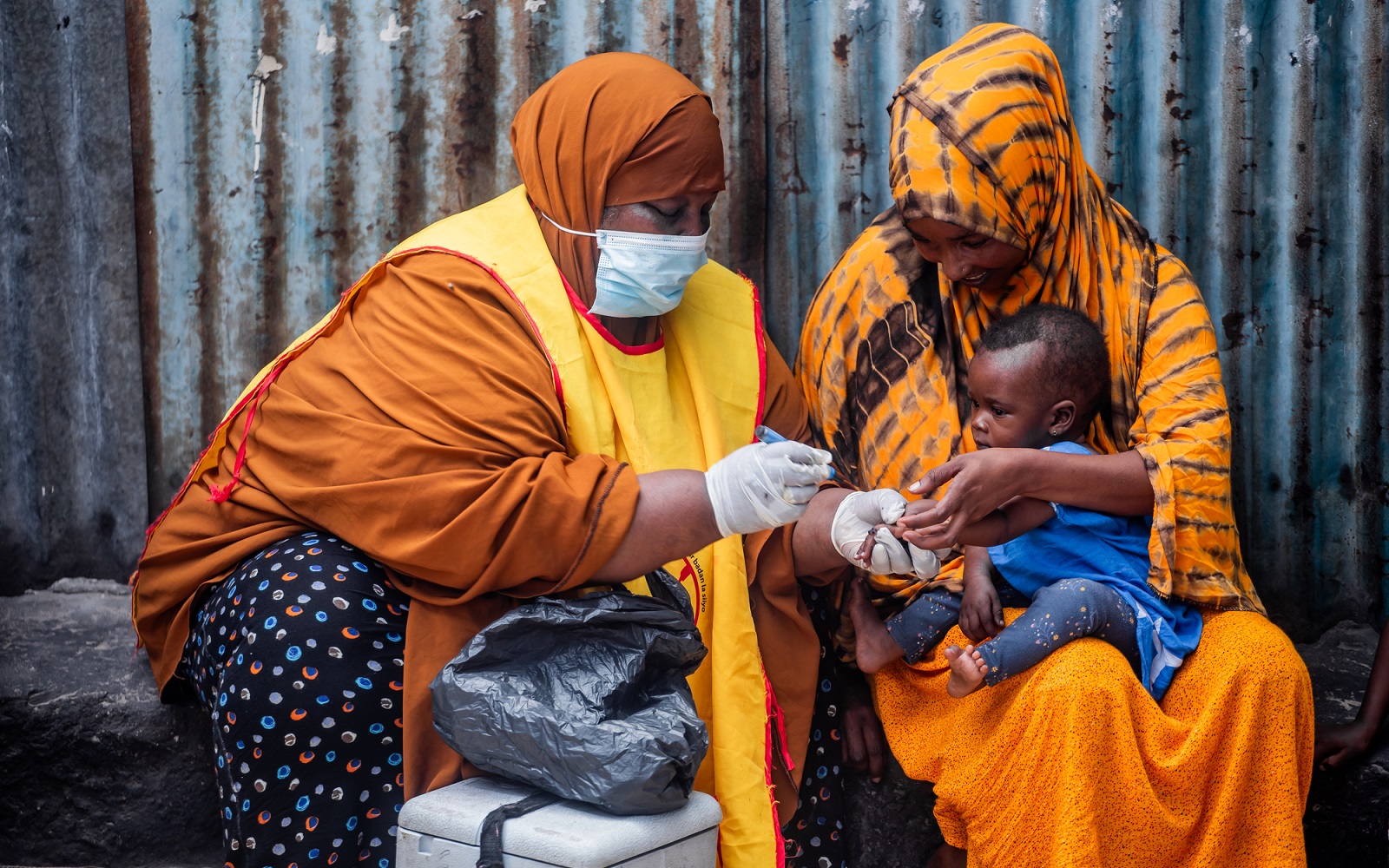
On a hot and humid morning in February 2021, Evans Lablah, an immunization specialist with UNICEF in Liberia, was working at his desk when he received an email with unexpected news: Variant poliovirus had been detected in the sewage system of Monrovia, the capital city.
It was a stunning setback. Liberia had been declared free of wild poliovirus 11 years earlier, three years after Lablah got his start in public health in a job overseeing a polio vaccine campaign in a rural district. Since then, the country had routinely tested sewage samples to look for signs of diseases that could be circulating in communities—an important component of a strong public health system.
The detection of variant poliovirus—a mutated strain of the weakened virus in oral polio vaccine--in the city’s sewage triggered a public health emergency and the formation of a rapid response team to search for the exact source in Monrovia. Lablah, by then a seasoned expert in vaccination campaigns, became part of that team, which included both UNICEF and World Health Organization staff.

Pursuing a career in health care
Lablah grew up in Monrovia during Liberia’s 14-year civil war, which lasted from 1989 to 2003. The second of five children, he enjoyed playing soccer and visiting his grandparents in their rural village, where he’d scare away birds from the rice fields and hunt antelope. But it was hard to escape the brutality of living in a war zone.
By the end of high school, he was desperate to leave the endless fighting. He had always wanted to study medicine, but the war had disrupted training at the country’s two medical colleges.
In 2001, Lablah received a scholarship to study nursing at a university in Morocco, despite not speaking Arabic or French, the main languages used in education there. He quickly began studying French, and in 2006 he received a nursing degree and returned home.
Liberia’s health system urgently needed trained workers. More than 95% of its health facilities had been destroyed or damaged in the fighting, and fewer than 20 doctors remained to treat the country’s 3.4 million people.
Lablah was sent to Grand Cape Mount County, a district in the northwest corner of Liberia whose population of 120,000 was scattered in remote villages. In global health, these are known as “last mile” areas because they are the hardest to reach with health services and are typically underserved.
Lablah and a midwife were the only trained health workers at one of the district’s five health clinics. They delivered babies and provided primary care services, including routine immunizations, nutritional screening, and maternal health care. Their interaction with patients was often the only contact locals had with the health system. The center lacked just about everything: regular electricity, running water, cellular service, and equipment such as ultrasound machines. Lablah’s US$145 monthly salary barely covered his food expenses.

“But as time went by,” he says, “I realized that this was a calling. It was about how I can contribute to humanity and make a difference.”
In 2007, Lablah became the district coordinator for polio campaigns and led a vaccination team to villages so remote that they had never been visited by a health worker. One of those places was Moila Island, which was an hours long walk from the next village and required stepping across a bunch of logs loosely tied together. In the team’s first attempt to reach the island, the worker carrying the vaccines fell into the water. The team was reluctant to try again, but Lablah reminded them that leaving any pocket unvaccinated would make the country vulnerable to future outbreaks. They returned the next day and vaccinated the 30 children on the island.
Over the next 15 years, Lablah’s commitment to community health care only deepened. Eventually, he joined the UNICEF Liberia team and began the hard work of strengthening Liberia’s immunization system to protect children from devastating diseases such as measles, polio, pneumonia, and diarrhea.
This was how he ended up sitting at a desk that day in 2021, staring in shock at the email announcing that polio had been detected in Monrovia’s sewage.
Polio makes a comeback
The positive sample came from the sewers of Redemption Ridge, a densely populated neighborhood in Monrovia. The team went to work trying to determine exactly who was infected so they could contain transmission of the virus.
Poliovirus is spread through contact with human waste, making young children—especially those living in settings that lack clean water and sanitation systems—the most susceptible to exposure. The virus enters the nervous system and can cause permanent paralysis and even death. Most infected people do not show any symptoms, however, so they never know they are infected. This gives the virus time to multiply inside their intestines before being released through their stool. The virus can then spread undetected until there is a case of paralysis, usually in an unvaccinated person, or it’s caught during regular testing of sewage samples.
The world has been close to eradicating all types of polio for decades. But those efforts have fallen short because of longstanding challenges including low immunization coverage rates, unsanitary living conditions, setbacks related to armed conflict, and weak health systems.


An effective rapid response includes a vaccination campaign to cover the outbreak area and those at risk. In Liberia, that meant vaccinating more than 800,000 children over a four-day period one month after detection of the virus, to stop the outbreak from spreading.
Read next